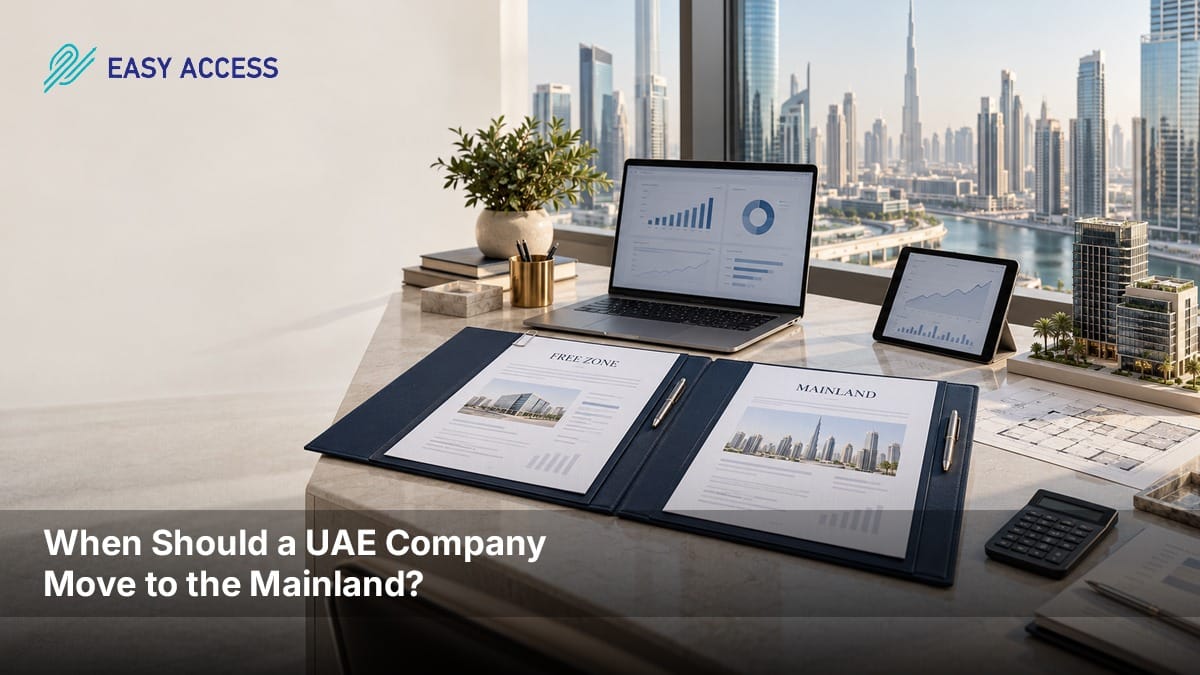
Choosing between a mainland and free-zone company is one of the first major decisions for entrepreneurs planning a Dubai business setup in 2026. The choice can affect where you operate, which activities you can undertake, how you access the UAE market and what ongoing compliance requirements you need to manage.
Neither structure is automatically better. The appropriate option depends on the nature of your business, target customers, operating model and growth plans.
Dubai’s business environment has also evolved. Free-zone companies now have additional routes to access mainland business activity through specific permits, while mainland businesses continue to offer a broad framework for companies serving the local market.
For an entrepreneur, the important question is therefore not simply whether the mainland or free zone is cheaper.
It is whether the structure supports how the business intends to operate today and how it plans to grow.
What Is the Difference Between Mainland and Free Zone?
A mainland company in Dubai is licensed through the relevant mainland authority, with business licensing managed by the Dubai Department of Economy and Tourism (DET) for applicable Dubai mainland activities. Mainland licences cover activities including commercial, professional and industrial businesses.
A free-zone company is established within a designated free-zone jurisdiction and is licensed by the relevant free-zone authority.
Both structures allow businesses to operate legally in the UAE, but they are governed by different authorities and can have different requirements relating to activities, premises, ownership, visas and market access.
The choice should therefore begin with the business model rather than the advertised package price.
When Does a Mainland Company Make Sense?
A mainland structure can be suitable for businesses that intend to operate directly across Dubai and the wider UAE domestic market.
For example, it may be relevant to businesses that:
- Serve customers directly across the UAE;
- Need a physical commercial presence;
- Work with local clients or organisations;
- Require activities that are better suited to mainland licensing;
- Plan to participate in government or local commercial opportunities; or
- Expect to expand their UAE operations over time.
Dubai’s mainland licensing framework includes commercial, professional and industrial licence categories, along with other specialised options depending on the activity.
This makes mainland setup particularly relevant when local market access is central to the business model.
However, entrepreneurs should still confirm the exact licensing requirements for their chosen activity. Certain sectors may require additional approvals or specific conditions.
When Can a Free Zone Be a Better Fit?
A free zone can be suitable for businesses whose operating model aligns with the facilities, activities and ecosystem offered by a particular free zone.
Free zones can be attractive to businesses involved in areas such as:
- International trade;
- Import and export;
- Professional services;
- Technology;
- E-commerce;
- Manufacturing;
- Logistics; or
- Other specialised activities.
The advantages available can differ significantly between free zones. Some focus on particular industries, while others provide broader commercial or professional activity options.
Free zones can also offer streamlined administrative processes, dedicated infrastructure and different office or facility solutions depending on the jurisdiction. The Federal Tax Authority notes that free zones can provide benefits such as modern infrastructure, developed business communities and relaxed foreign ownership restrictions.
That does not mean every free zone offers the same terms.
The correct comparison should therefore be between the actual requirements of the business and the rules of the specific free zone being considered.
Does Mainland Mean You Need a Local Partner?
This is one of the most common assumptions entrepreneurs make when considering a Dubai business setup.
For many mainland activities, 100% foreign ownership is possible, subject to the applicable laws and activity-specific requirements.
However, ownership rules can vary depending on the nature of the business and any sector-specific regulations.
Entrepreneurs should therefore avoid relying on older assumptions about mandatory local ownership. The correct approach is to check the ownership conditions applicable to the specific business activity and legal structure before incorporation.
This is particularly important for regulated sectors where additional approvals may apply.
Can a Free-Zone Company Do Business in the UAE Mainland?
A free-zone company can conduct business internationally and within the scope permitted by its free-zone licence. Direct mainland activities may be subject to applicable rules and approvals.
Dubai introduced a Free Zone Mainland Operating Permit in 2025, creating a structured route for eligible free-zone companies to operate in Dubai’s mainland under the relevant permit framework. The initiative was designed to make cross-jurisdiction operations easier and provide free-zone businesses with additional routes to engage in domestic trading and government contracts.
This is an important development for entrepreneurs considering a free-zone structure.
However, it does not mean that every free-zone company can automatically conduct every mainland activity without additional requirements.
The applicable permit, activity, authority conditions and operational requirements should be checked before making the decision.
Mainland vs Free Zone: What About Business Activities?
Your intended business activity should be one of the first things you identify before comparing structures.
A mainland licence can cover activities ranging from professional services and consultancy to commercial trading and industrial production.
Free zones also offer a wide range of activities, but the available options depend on the specific free-zone authority.
For example, a technology business may find a specialist free zone with relevant infrastructure and an established industry ecosystem useful. A consultancy serving UAE clients may instead prioritise a structure that makes its domestic operating model straightforward.
The important point is that the licence must match the actual business activity.
Choosing a jurisdiction first and trying to fit the business into the available activities afterwards can create unnecessary complications.
Which Option Is More Cost-Effective?
There is no universal answer.
The cost of a Dubai business setup depends on factors such as:
- Business activity;
- Licence type;
- Jurisdiction;
- Office or workspace requirements;
- Number of visas;
- Government approvals;
- Immigration requirements;
- Banking and accounting needs; and
- Ongoing renewal and compliance costs.
Free-zone packages can sometimes appear more straightforward because certain services are bundled together. However, the headline package price does not necessarily represent the total cost of operating the business.
A business requiring additional visas, office space, approvals or operational facilities may have a different overall cost.
Similarly, a mainland company may have different cost requirements depending on the activity and premises.
Entrepreneurs should therefore compare the full setup and operating cost, rather than choosing based only on the initial licence fee.
What About Corporate Tax?
Mainland and free-zone businesses are both part of the UAE Corporate Tax framework, subject to the applicable rules.
A common misconception is that establishing a company in a free zone automatically means that no Corporate Tax applies.
That is not correct.
A free-zone entity must meet specific conditions to qualify as a Qualifying Free Zone Person (QFZP) and benefit from the 0% Corporate Tax rate on qualifying income. These conditions include maintaining adequate substance in the UAE, deriving qualifying income, complying with transfer pricing requirements and meeting other applicable conditions.
The 0% rate therefore applies to qualifying income under the relevant rules. It is not a blanket exemption for all income earned by every free-zone company.
Free-zone entities are also required to register for Corporate Tax and file Corporate Tax returns, regardless of whether they qualify as a QFZP.
For this reason, tax treatment should be considered as part of the structure decision, but it should not be the only reason for choosing a free zone.
Does the Business Structure Affect Banking?
The choice of jurisdiction can form part of the information considered during corporate bank account applications.
Banks typically assess factors such as:
- Nature of the business;
- Ownership structure;
- Expected transaction activity;
- Source of funds;
- Customer and supplier markets;
- Supporting documents; and
- Overall business profile.
A business should therefore establish its operating model before approaching banks.
A licence alone does not guarantee corporate bank account approval. Banks conduct their own due diligence and compliance checks.
For entrepreneurs setting up a new UAE company, having clear business documentation, a defined activity and an understandable transaction profile can make the banking process more structured.
What Should You Consider Before Choosing?
Instead of comparing mainland and free-zone companies only on price, consider the following questions.
Where will your customers be?
If your business is primarily serving UAE customers, mainland access may be an important consideration.
If your model is primarily international or focused on a specialised business ecosystem, a free zone may be worth evaluating.
What activity will you conduct?
Check whether the intended activity is available under the proposed licence and whether additional approvals are required.
Do you need physical premises?
Office and facility requirements vary depending on the jurisdiction and business activity.
A business that needs a warehouse, retail location, clinic, workshop or other specialised facility may need to approach the setup differently from a consultancy operating from an office.
How many visas will you need?
Visa eligibility and capacity can depend on the licence, premises and jurisdiction.
This should be considered when calculating the actual cost of setting up and operating the company.
How do you plan to grow?
A structure that works for a small consultancy may not necessarily be ideal for a company planning to expand into trading, warehousing, local contracts or multiple business activities.
The business structure should therefore be reviewed against the expected growth path.
What Documents Are Usually Required?
The exact documentation depends on the business structure, activity, authority and shareholders.
Common requirements may include:
- Passport copies of shareholders and managers;
- Proposed company or trade name;
- Business activity details;
- Application forms;
- Proof of address or relevant supporting documents where required;
- Business plan or additional information for certain activities; and
- Additional approvals or documents for regulated activities.
Requirements can vary by jurisdiction and activity.
Applicants should confirm the current document checklist with the relevant authority before submitting an application.
Should You Choose Mainland or Free Zone in 2026?
The answer depends on what your business needs to do.
A mainland company may be appropriate when direct access to the UAE domestic market, local operations or broader mainland activity is central to the business.
A free-zone company may be suitable when the business benefits from a specialised ecosystem, international operations, particular infrastructure or the framework offered by a specific free zone.
There is also more flexibility than the traditional mainland-versus-free-zone comparison suggests. Dubai’s Free Zone Mainland Operating Permit provides eligible free-zone companies with a structured route to certain mainland operations.
The right structure is therefore the one that supports the company’s actual operating requirements rather than the one that appears cheapest or simplest on paper.
How Easy Access Can Help With the Decision
Choosing the right jurisdiction involves more than completing an application. Entrepreneurs need to consider business activity, ownership, licensing, banking, premises, tax obligations and future operational requirements together.
Easy Access Management Consultancy supports UAE entrepreneurs with Strategic Advisory, Government Relations, Banking Support and Post-Setup Support.
The focus is on helping businesses understand the structure they are choosing, organise the required documentation and navigate the setup process with clearer expectations around costs and compliance.
For founders comparing mainland and free-zone options, this structured approach can help connect the initial setup decision with the practical requirements of running the business afterwards.
Plan the Setup Around the Business, Not the Package
Mainland and free-zone structures both have a place in Dubai’s business environment.
The important distinction is not which option is universally better. It is which option fits the business activity, target market, operating model, premises, ownership requirements and growth plans.
A founder planning a Dubai business setup in 2026 should therefore begin with the business model, then evaluate the appropriate jurisdiction.
Once that decision is clear, licensing, documentation, banking, tax registration and post-setup compliance become easier to organise.
Easy Access Management Consultancy approaches business setup with the same principle: operational clarity drives business performance.
The objective is not simply to establish a company. It is to establish a structure that the business can operate and grow within with greater clarity.
Frequently Asked Questions
Is the mainland or free zone better for a Dubai business?
Neither is universally better. Mainland may suit businesses focused on the UAE domestic market, while a free zone may suit businesses seeking a specialised ecosystem or international operating model. The right choice depends on the activity, customers, premises and growth plans.
Can foreigners own 100% of a Dubai mainland company?
100% foreign ownership is available for many mainland business activities, subject to applicable laws and activity-specific requirements. Certain regulated activities may have additional conditions, so ownership rules should be checked for the proposed activity.
Does a free-zone company pay Corporate Tax in the UAE?
Free-zone companies are within the UAE Corporate Tax framework. A Qualifying Free Zone Person may benefit from a 0% rate on qualifying income if the applicable conditions are met. Other income may be subject to the standard Corporate Tax rules.
Can a free-zone company operate in the Dubai mainland?
A free-zone company may conduct mainland activities subject to applicable rules and approvals. Dubai’s Free Zone Mainland Operating Permit provides an additional structured route for eligible free-zone companies to operate on the mainland.
How should I choose a jurisdiction for my Dubai business setup?
Start with your business activity, target customers, premises, visa requirements, banking needs, tax position and growth plans. Then compare the mainland and relevant free-zone options based on those requirements rather than the initial package price.